
Anne in Amsterdam
About the Book
Anne in Amsterdam tells Anne Frank’s story from a deeply human and intimate point of view: a thirteen-year-old girl like any other, who goes to school, has friends and dreams of writing. But the shadow cast over the world those years is no metaphor—something invisible and brutal advances, turning normal days into moments of fear, uncertainty, and decision.
María Inés Falconi reimagines the last days prior to Anne and her family’s confinement with great sensitivity, capturing the tension of a life that comes apart and gets rebuilt every single day. This is not merely a historical novel but an invitation to walk a mile in the shoes of a young girl who, in the face of the unimaginable, holds on to her words, her hope, and her outlook.
Through a prose that combines historical rigor with emotional power, Anne in Amsterdam becomes an essential read for young people and adults, perfect for stimulating reflection about freedom, courage, and the power of imagination in the darkest times. A story that teaches, moves and endures.
Excerpt
This was the plan: Anne would go to the public library to look for a city map and try to locate Nieuw Hoogstraat. She would make a copy by hand as best she could, and then they would all go to get Ru.
They had no idea whether the address was near or far, and that mattered because they might have to walk or ride their bikes. Anne thought maybe she could borrow one from Margo. She would have to give something in return—she already owed her quite a few favors. She also didn’t know whether she could tell Margo the truth without risking that she would tell her mother.
But that was a problem for later. What she needed now was to get in touch with Hello and get him to go to the library with her. It was a good chance to be with him, since she was not allowed to go to the match…
Outside, she looked for Wilma.
“I need you to do me a favor,” she said.
“With Hello? Do you want me to tell him you like him?”
Oh—big mistake turning to Wilma!
“No, Wilma, no. I don’t want you to say anything to him.”
“Oh…” Wilma was disappointed. “What a shame… because there’s something I need to tell you.”
Wilma knew how to gossip. Anne couldn’t resist her curiosity; however, she tried to seem uninterested.
“What is it?” she asked.
“It turns out Hello came over to my house the other day.”
“Oh, really?... I didn’t know. And then?...”
“And I asked him, who do you like better, Ursula or Anne? And he told me it was none of my business.”
“Of course.”
“Yes, but wait,” Wilma went on. “Before he left, he said, ‘Anne, but don’t tell anyone.’”
“Oh… I see you kept your word,” Anne said ironically, trying not to jump for joy.
“I didn’t give my word, just so you know. But don’t you think it’s wonderful?”
“Yeah, maybe… So, do you know his phone number or not? I need to get in touch with him, but I don’t have his number and don’t know where he lives. Do you?”
“Of course…,” Wilma played coy. “You are so slow, Annie! I would have asked him everything by now.”
“Well, I didn’t think of it. Do you or do you not know?”
“Yes, I do. Address or phone number?”
“Whatever you like.”
Wilma opened her school satchel, took out an address book, looked for Hello and said, “Write it down.”
“Wilma… do you keep a notebook with all the people you know and their addresses?” Anne wondered. It was strictly forbidden for her to write down names or information; that’s why her mother had made that very strange annotation on her ration book.
“Of course,” Wilma said. “I’m not memorizing them.”
“But, Wilma… nobody told you that could be dangerous?”
“No, because there are no names. Just initials.”
“Does your mom know?”
Wilma hesitated.
“No, she doesn’t,” she said at last. “You are not going to tell her, right?”
“No, because they’d get really mad at you, but throw it away, Wilma. Or better—burn it. My dad says we mustn’t write down anybody’s name. Or address…”
“Well, I don’t know… Look how handy it was for you that I had everything written down. Do you want Hello’s number or not?”
“Ok, yes—tell me. And then get rid of the notebook.”
“Are you going to tell?”
“No, I’m not. But throw it away.”
Wilma gave her the number and Anne wrote it down on the palm of her hand. She was sure Wilma wouldn’t throw her notebook away, and wondered whether she should tell someone. What if her name was in it?
She left that problem for later too and walked all the way back home repeating Hello’s number until she knew it by heart.
As soon as she got home, she washed her hands and went to the kitchen to find her mom.
“Mom… can I invite Hello over for tea this afternoon like you said?
“Yes, sure. I’ll see if I can get in touch with his mom.”
“Don’t worry. I have his number. Wilma gave it to me.”
She thought this way she could alert her mother without revealing that Wilma kept a notebook of addresses. There was nothing else she could do. She had given her word. She ran to the phone and dialed.
Fortunately, Hello was at home and accepted the invitation before Anne had even finished. She said nothing about the library—that she could tell him in person. Anne took off her school uniform and picked a blue dress she liked very much to wait for him. She combed her hair eight hundred times and would have even put on a little lipstick if her mom had allowed it.
She set the table, helped with the pastries and sat down to wait. She was nervous—she didn’t know whether it was because Hello was coming over or because she had to go to the library to do something secret. The plan was to go with him after tea. A plan nobody could say no to. What could be more saintly than going to the library?
Hello arrived punctually. He, too, out of his school uniform, his hair combed with gel into a side part, and holding a bouquet of flowers for Anne’s mom. A lovely boy.
They all sat around the table, including Margo, who kept giving Anne deliberate little glances. Too bad she had to borrow her bike! Otherwise she would have kicked her under the table.
Tea was truly boring. Once the usual questions had been asked—‘How are your parents?’, ‘How is school going?’, ‘Do you like Amsterdam?’...—there wasn’t much to say. They fell into a silence in which they looked at each other and giggled. Anne waited for the appropriate time to ask permission to go to the library, which was the only thing that mattered to her besides Hello or going with Hello.
She suddenly said, “Miss Kohl gave us an assignment about Amsterdam.”
“How interesting!” her mom remarked.
“Yes, I need to look for the maps in the library,” Ana added.
“That’s very good.”
“I could go now…,” she said, looking at Hello.
“But, Anne! You just invited Hello over. How can you possibly send him away like this? You should have thought of that before…,” her mom scolded her.
“Well… Hello could come with me,” she suggested with an innocent face.
“Oh, really?” Margo remarked.
Anne glared at her.
“There’s no problem with me,” Hello said. “I wouldn’t want you to get bad grades because of me. I can go with you.”
“Can we?” Anne asked.
It was the million-dollar question.
“Okay, go. But can you bring her home afterwards, Hello?”
“Sure, Miss Frank.”
Come on!!!
“And come back before nightfall.”
“Yes, mom. Thank you.”
Anne kissed her, glanced at Margo, who hadn’t fallen for the whole homework business, and they were out faster than a speeding bullet.
As soon as the door closed, Anne jumped.
“Bravo! Teas are the most boring thing in the world.”
“Do you seriously need to go to the library?” Hello hadn’t fallen for her excuse either.
“Seriously.”
And Anne told him the whole plan from the start.
Translated by Martín Juan - Edited by Alejandra Rogante
Other related titles
-
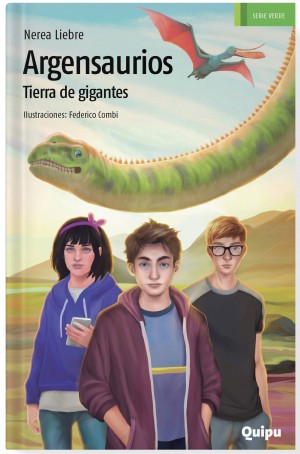
Quipu
Argensaurs
Argensaurios. Tierra de gigantes
2019
Children's fiction -

Limonero
Everything that Happened Before You Came Along
Todo lo que pasó antes de que llegaras
2023
Children's fiction -

Lecturita Ediciones
My Dad is a Tlacuilo
Mi papá es un tlacuilo
2021
Children's fiction -

del Naranjo
Pretty Rita
Rita bonita
2019
Children's fiction