
A Round Dream
Contact
About the Book
In A Round Dream, Sabina Schürmann builds an illustrated album where literature and geometry enter into a precise poetic dialogue. Through the story of a square king -rigid and confined within his own shape-, the narrative explores the desire for change and the possibility of transformation.
When a circular tear suddenly breaks into his world of right angles, something unexpected happens ─a curve appears as a gateway to tenderness, imagination, and freedom.
With its musical prose and a carefully crafted visual interplay of shapes, colors, and symmetries, the book invites readers to discover that even the most rigid structures can open up to surprise. A delicate and profound album that turns geometry into an emotional metaphor and celebrates the transformative power of joy.
Excerpt
Once upon a time, there was a square king
who used to live with his rhombus army,
all day trapped within his own geometry.
He was always angry, this square king,
grumbling at the straight lines of his palace
and the obtuse soldiers who obeyed him blindly.
But his orders and complaints
would not set him free.
The king was a prisoner
of his own monarchy.
So he waited for the right moment
to make a royal wish:
That the day might bend
upon his command, instantly.
He closed his eyes and blew the candles
(His soldiers did it too,
though it was all in vain, as you can see.)
But not even all the wishes in the kingdom
could reach his dream and break monotony.
He went out for a walk around his trimmed maze
and among the sharp angles
he scratched a wounded line in symmetry.
So very sad was our square king
that a circle rolled down his cheek
leaving on the floor a round stain.
Could it be a mirror? A seed?
The stain drew on the king
a gentle line, soft and curved like a smile
that bent the edges of his melancholy.
And so, the square king found within himself
the curve that would smooth his days,
and he could, at last, enjoy his round fantasy.
Translated by Sandra Botta - Edited by Cecilia Della Croce
Other related titles
-

Pípala
A Journey to the Bottom of the River
Viaje al fondo del río
2021
Illustrated album -
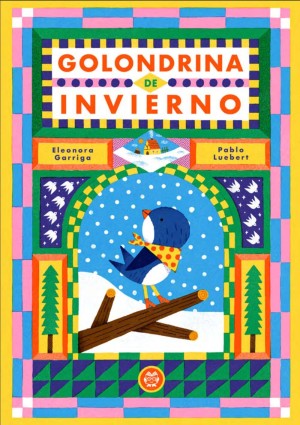
Lecturita Ediciones
A Winter Swallow
Golondrina de Invierno
2025
Illustrated album -
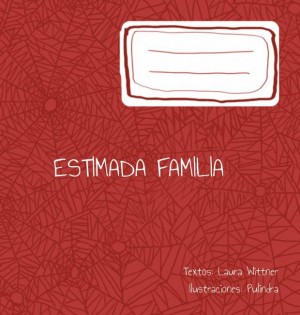
la marca editora
Dear family
Estimada familia
2020
Illustrated album -
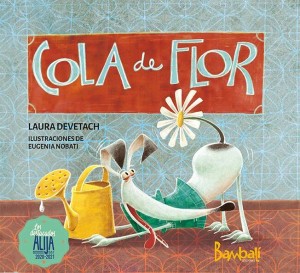
Bambali Ediciones
Flower Tail
Cola de flor
2021
Illustrated album